
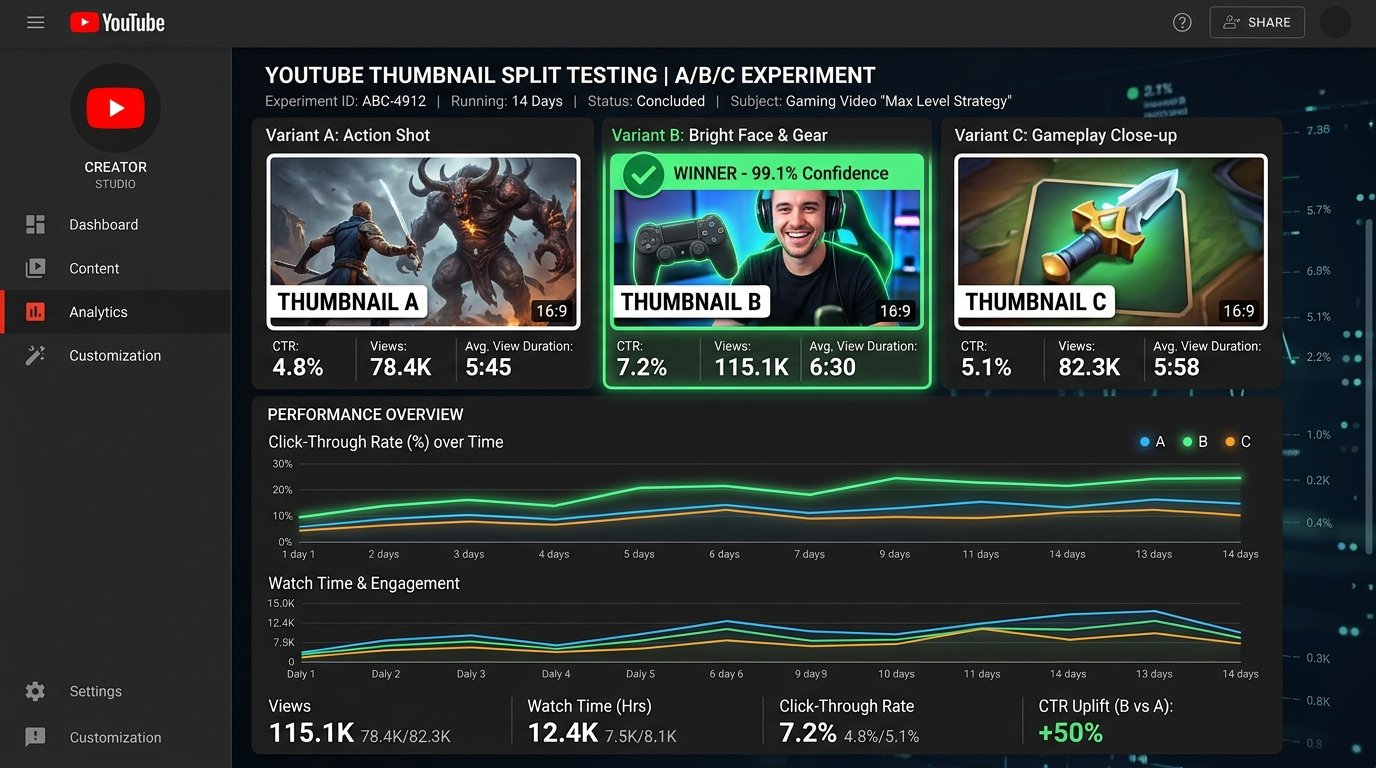
For years, YouTube creators relied on expensive third-party browser extensions like TubeBuddy or VidIQ to split test thumbnails. Those external tools had a massive flaw: they had to rotate your thumbnail every 24 hours, meaning external variables—like day of week, trending news, or weekend traffic spikes—heavily contaminated the results.
With YouTube's native Test & Compare feature fully rolled out across YouTube Studio, the game has changed. You can now serve up to 3 thumbnails simultaneously to random slices of your audience in real time.
Here is how to set up split tests correctly, interpret YouTube's metrics, and avoid common testing mistakes.
1. The Big Shift: Why YouTube Measures "Watch Time Share" (Not Just CTR)
Most creators assume thumbnail split testing is a pure Click-Through Rate (CTR) contest. It isn't.
YouTube's algorithm determines the winning thumbnail based on Watch Time Share (Total Watch Time generated per impression), not raw clicks.
If Thumbnail A promises an outrageous explosion and gets an 8% CTR, but viewers realize it was clickbait and leave after 15 seconds, that thumbnail harms user retention. Meanwhile, Thumbnail B gets a 5% CTR, but viewers stay for 12 minutes. Thumbnail B generates 3× more total watch time for YouTube, keeping viewers on the platform. Therefore, YouTube will declare Thumbnail B the winner.
2. How to Set Up a Test & Compare Experiment in YouTube Studio
- Open YouTube Studio on your desktop browser.
- Navigate to Content and select the video you want to optimize.
- Under the Thumbnail section, click the three vertical dots (Options menu) on your active thumbnail.
- Select Test & Compare.
- Upload up to 3 variations (Variation A, Variation B, and Variation C). Ensure all files meet the 1280×720 standard and are under 2 MB.
- Click Save and Run Test.
3. The 3 Types of Variations You Should Actually Test
The biggest rookie mistake in thumbnail A/B testing is testing tiny, insignificant micro-tweaks—like changing a small font from yellow to white, or shifting an arrow 20 pixels to the left. These tests take weeks to reach statistical significance and teach you nothing about viewer psychology.
Top channels test fundamentally different visual concepts:
Test 1: Face Emotion vs. Object Focus
Variant A: A tight close-up of a human face expressing intense shock or skepticism.
Variant B: No face at all. Just the high-contrast product, dramatic environment, or intriguing prop.
What you learn: Does your audience care more about personal human connection or mysterious objects?
Test 2: Minimalist (Zero Text) vs. 3-Word Hook
Variant A: Pure visual storytelling with zero text overlays.
Variant B: Bold, 3-word question or provocative counter-intuitive claim.
What you learn: Does text enhance curiosity or clutter the mobile viewport?
Test 3: Dark/Mysterious vs. High-Key Vibrant
Variant A: Moody, cinematic lighting with heavy shadows and deep blues.
Variant B: High-key, bright studio lighting with punchy warm yellow and cyan accents.
What you learn: Which color temperature pops against YouTube's dark/light mode browse feed?
4. How Long Should You Let an A/B Test Run?
YouTube's test duration depends entirely on your video's velocity (how many impressions it receives per day):
- High-Velocity Channels (>100k views/day): Tests often conclude within 24 to 72 hours with a clear statistically significant winner.
- Medium-Velocity Channels (1k – 10k views/day): Expect tests to take 7 to 14 days.
- Small / Growing Channels (<500 views/day): Tests may take up to 2 weeks. If after 14 days YouTube shows "No clear winner", it means the variations were too similar in performance—pick the one you like best and move on to your next video.
5. How to Retrieve Lost Thumbnail Variations
When YouTube finishes an experiment, it automatically locks in the winning thumbnail as the active cover. But what if you want to inspect which cover image won on desktop or download high-resolution backups of the live artwork?
You can paste your video link into YTSnapIt at any time to instantly pull the official 1280×720 maxresdefault.jpg cover currently active on YouTube's public CDN.
6. The 3-Concept Framework: Never Test Micro-Tweaks
The number one mistake creators make when running their first A/B test is testing trivial cosmetic adjustments. Changing a font from Montserrat to Roboto, nudging an arrow two pixels to the left, or switching text color from yellow to green rarely moves the needle. Subtle tweaks produce statistically inconclusive "tie" results that drag on for weeks.
Instead, top YouTube growth agencies adhere to the 3-Concept Framework:
- Variation A (The Emotion Angle): High-intensity facial expression looking directly toward a focal point, establishing an immediate human empathetic connection.
- Variation B (The Intriguing Object / Result Angle): The human face is minimized or removed completely, putting 100% of the visual focus on the dramatic object, transformed environment, or final shocking outcome.
- Variation C (The Curiosity Gap / Mystery Angle): A visual question mark—a hidden safe, a blurred mysterious shape, or a split-screen before/after comparison that forces the human brain to seek visual closure.
By testing three fundamentally distinct psychological hypotheses, YouTube's algorithm will rapidly identify which human curiosity trigger resonates strongest with your target demographic.
7. The 48-Hour Fallacy: Why Stopping Early Kills Channel Momentum
During the first 24 hours of a new upload, YouTube predominantly serves your video to your most dedicated core subscribers. These core fans will click almost anything you upload because they already trust your personal brand.
As the video exhausts your immediate subscriber base and expands into browse features, home recommendations, and suggested sidebar feeds, your impressions shift to broad, unfamiliar cold audiences. A thumbnail variation that won during the initial subscriber burst might plummet when shown to strangers, while a high-clarity variation that started slow might steadily dominate broader audiences.
The Rule: Never terminate an A/B test before 48 to 72 hours have elapsed. Allow YouTube's machine learning models to gather at least several thousand impressions across both browse and search discovery traffic before locking in a permanent winner.
Inspect Competitor A/B Test Winning Thumbnails
Analyze high-performing thumbnails in your niche. Extract full-bleed 1080p covers to build competitive moodboards in Figma or Photoshop.
Inspect Thumbnails with YTSnapIt